Thursday, 25 July 2024

"When God Became White" is a Neo-Gnostic Book About Worshipping the Divine Feminine

"When God Became White: Dismantling Whiteness For A More Just Christianity" by Grace Ji-Sun Kim is an awful book. It is unabashedly racist, lacks historical nuance, is unscholarly, and is heretical in all of its notions of who God is. Grace's thesis is God is not a white man and we should worship the divine feminine. 


I am not going to dwell on the historical aspects of this book. That would take way too long because it is chock full of bad history. Instead I want to focus on its spiritual aspects. The page numbers used are from a PDF and might not reflect the actual book's numbering.

Here are just a few examples of the bad history contained within the pages of this book.

It was Augustine who developed the just-war theory in the fifteenth century based on the understanding that there are worse evils than physical destruction. This just-war theory has been a dominant Christian empire-building position used repeatedly since Augustine’s time to wage wars and crusades.

pg. 48

During the European Renaissance (1350–1600 CE), Leonardo da Vinci’s Last Supper and Michelangelo’s Last Judgment were painted on the ceiling in the Sistine Chapel.

pg. 102
This is completely wrong because Augustine did not live in the 15th century and da Vinci's The Last Supper is in Milan which is far from the Roman Sistine Chapel. Are these typos? How could an editor overlook these obvious errors? If Grace cannot get something so small correct then how can she be trusted with her overarching thesis which embraces world history and the development of Christianity? She cannot be trusted.

During the COVID pandemic there were many attacks on people of Asian descent in the USA. Grace claims those attacks were a by-product of whiteness.

And again, we saw a surge of hate crimes during the Covid-19 pandemic where elderly and young Asian women were beaten, kicked, yelled at, and even murdered. The Atlanta spa shooting in 2021 resulted in the murder of eight people in a rampage at three spas. Six out of the eight murdered were Asian, and this violent act has become an ongoing pattern.

pgs. 80-81
It would be tedious to point out the fact that the majority of those incidents were not hate crimes but the acts of mentally disturbed black homeless men. The spa rampage in Atlanta was also not a hate crime but 
the result of a sex addiction that conflicted with (the killer's) religious beliefs.
Those facts are inconvenient to the leftist racist screed that is this book so they are excised.

Finally, no anti-white book is complete without mentioning Trayvon Martin.

On February 26, 2012, a seventeen-year-old African American boy, Trayvon Martin, was shot dead by George Zimmerman while walking home to his father’s fiancée’s townhouse in Sanford, Florida. The life of this young, innocent Black boy was taken because he was perceived as being in the wrong neighborhood.

pg. 120
Wrong. Plain wrong. Here are the facts of the case and as laid out before a jury. A gated community had been suffering a rash of break-ins. Community watchman George Zimmerman, a Hispanic man, saw a person he did not recognize and considered suspicious. After calling 911 he decided, against advice, to confront Martin. Martin violently assaulted Zimmerman causing Zimmerman to fire his gun in self-defense. Trayvon Martin was by no means the innocent cherub which the media and leftists portray him as.

Photo of George Zimmerman taken after the shooting

After the initial investigation Zimmerman was cleared of any wrong doing. It was not until a nationwide outcry arose that he was finally charged with murder. A jury trial acquitted him of all charges. The fact that this lady is continuing to push such a blatantly false narrative 12 years after the fact says all we need to know about her and this book. She is not serious and she is a liar. The review could end here but we shall press on to the spiritual aspects.

Grace Ji-Sun Kim spills a lot of ink disparaging missionaries who spread "The White Good News" and ignored native cultures and religions believing theirs was superior.

European Christianity was transported to Africa without any respect for African religions, spirituality, culture, and their rich religious history.

pgs. 55-56

Christians need to honor and respect indigenous traditions and carefully listen to their prayers, regalia, songs, sacred drumming, and dance. The white church must come to welcome and recognize indigenous peoples as a vital part of God’s community and kingdom on earth.

pgs. 60


These two sentences tell us that Grace does not see any difference between Christianity and non-Christian religions. Praying to Jesus Christ is just the same as sacred drumming to the Great Spirit. What would she say to Paul and the other Apostles who travelled the world to preach Jesus Christ? What would she say to Jesus Christ who commanded them to do so? What exactly is her view of The Great Commission?

Grace thinks white missionaries are not really preaching Jesus Christ and Him crucified but "whiteness" which is really just racism.


As white Christianity spread, it impacted and molded the identities of people of color around the globe in an attempt to Anglicize these other cultures. Part of the “good news” that was shared was intended to separate people of color from their own cultural heritages and customs and adopt a white Christian identity, practice, and religion.

White Christianity, which was disseminated by European missionaries and adopted through white enslavers, is not the true Christianity that it has routinely positioned itself to be. True Christianity cannot and should not endorse racism, xenophobia, subjugation, discrimination, domination, colonialism, or enslavement. Christianity through the lens of the powerful, the mighty, or the colonialist cannot be the real Christianity of love, liberation, and hope that Jesus shared as he walked the earth. This is not good news. Therefore, it is necessary to recognize the colonizer aspect of white Christianity, unpack and dismiss its defining components, and move toward a Christianity that is truly liberating and empowering for all people of color.

pgs. 71-72
This whiteness shows up in Christian theology.

Throughout the history of Christian theology, all the major theologians have portrayed God as male and white. For example, Anselm of Canterbury presents a theory of atonement that portrays God as a European feudal lord. Martin Luther uses male pronouns to speak about God and talks about God as ruler of the two kingdoms. These are masculine attributes and ideals. The problem with this representation is that it stratifies and systematizes a faith that is supposed to embrace the idea that all people are equal. This social understanding has damaged all other ethnic groups and led to the attempted destruction of other cultures.

pg., 87
Grace never explains her comments on Anselm. She never takes the time to explore and unpack his theology and prove why it is white and thus wrong. As for Luther, is Grace totally unaware that the Bible represents God as a king and refers to Him as He? Of course she is. Regal and male pronouns are problematic.

It is not just the whiteness of God that is problematic but also the gendering of God as a man. These two identities of whiteness and maleness that were cast on the Christian God have influenced church doctrines, liturgy, prayer, hermeneutics, and the life of the church. This gendered God is emphasized in the Old Testament as well as in the New Testament. Male pronouns and nouns have been used throughout the Scriptures to describe and refer to God. It is strange that throughout church history, strong patriarchal words such as KingMasterLordSovereign, and Almighty are used to talk about a loving and graceful God. In light of sexism, gendered violence, and other atrocities committed against women in society and in Christianity, this white gendered understanding of God is clearly problematic.

A gendered God legitimizes and promotes patriarchy and discrimination, and it subordinates and problematizes women in church and society. When racism and sexism intersect, women of color—especially Black women—endure the greatest hardships and atrocities.

Women live in a world where men push them to assume the status of the other, and they have become subjugated in society, family, and under religion. This dynamic is demonstrated in various spheres of society and in relationships such as in traditional marriages, family relationships, and the church where men have power over women.

To make women into an other benefits men greatly. Simone de Beauvoir believes that men view woman as a sexual partner, a reproducer, an erotic object—an other through whom he seeks himself. Women have been objectified by men throughout centuries in many cultures and societies. As objects, women can be violated, abused, and sexually assaulted without any fear of repercussion. In our world where so much of our existence is cast in dualistic terms, the division this creates prevents us from being able to embrace hybridity, ambiguity, and trans identity. 

pg. 131
According to Grace "strong patriarchal words such as KingMasterLordSovereign, and Almighty" are antithetical to love and grace. Proof? None. She asserts it and moves on to stating that these patriarchal terms lead to the subjugation of women "in relationships such as in traditional marriages." Yeah, Grace is against traditional marriages but is gung-ho for trans identity. What is a woman, Grace?

How did Jesus become white anyway? It has to do with power.

So how did an olive-brown-skinned Jesus become white, and what is the purpose of having a white Jesus and a white God? It has to do with power. A white Jesus and a white God are created and reinforced by the desires of those who held power and authority. During the Roman Empire, an olive-brown-skinned Jesus was not useful for the expansion of their empire and kingdom. They needed a white Jesus who resembled them to validate their dominance, dominion, and authority. An olive-skinned Jewish Jesus would have opened the door to there being a different authority, so he became white with blue eyes and blond hair to resemble those who were already in power—the Roman Empire.

pg. 100
What follows are several paragraphs of unproven assertions with very little footnotes. Grace is making it up as she goes. 

According to Grace not only is a white Jesus harmful but so is the Biblical imagery of whiteness as purity from sin because it alienates people of color.

The white European early churches found it easy to make Jesus white as there are biblical references to white being good, pure, and beautiful and tradition of white Europeans inventing a white Jesus. It was so widely believed that this was the “true” image and likeness of Jesus, that Brown, Black, and Asian people around the globe hung this image in their churches, homes, and offices as a way to exhibit their Christian faith and belief in Jesus.

Black being associated with night and evil. The equating of whiteness with purity and goodness in the Bible created the perfect vehicle for whitewashing Jesus. The notion of the color white as good has been transferred to Jesus, who is seen as pure, perfect and holy. John 1:29 states, “Here is the Lamb of God who takes away the sin of the world.” Lambs are depicted as white and pure even though they come in different colors. Think of the nursery rhyme: “Mary had a little lamb; its fleece was white as snow.” This imagery of Jesus as the pure sacrificial Lamb of God reinforces and sustains the idea of Jesus being white.

Scripture also states, “If your sins are like scarlet, will they become like snow? If they are red like crimson, will they become like wool?” (Isaiah 1:18). Sin is bad and we are stained/tainted by it, but once we are forgiven, we will be made white as snow. The perpetual focus on white imagery in the Bible as an indicator of goodness and purity alienates people of color.

pg. 102-103
Proof? What is the proof that the Biblical imagery of whiteness "alienates people of color?" There is none offered. Since she offers no proof her claim must be dismissed as frivolous. 

Furthermore calling Jesus Light and contrasting him with darkness is harmful dualism. Calling Jesus Logos is also harmful because it is masculine. Sophia, the divine feminine, is a better choice.

In John 8:12, Jesus says, “I am the light of the world,” which means he is pure and good. Jesus came into the world to bring light into darkness. Jesus is the light, and light is goodness and stands in contrast to the darkness, which is evil and bad. The writer of John lived in a dualistic world, and he incorporates that dualism into the imagery of Jesus as the light in a dark and evil world. Darkness and light are separate and cannot be brought together.

Dualism is very problematic as it divides the world into two categories in which there can be no harmony. In this dualistic world, Jesus can only be viewed as white and male as both categories are lauded as good and desirable. The feminine is on the opposite end of the spectrum from the male.

Within dualism, we also see the contrast of knowledge, or the masculine logos, as better than wisdom, or the feminine Sophia. The preference for logos over Sophia also leads to a male Jesus. Jesus is understood as the word of God; as Scripture states, “in the beginning was the Word, and the Word was with God, and the Word was God” (John 1:1).

pg. 104

That's right Grace thinks the word Logos should be replaced by Sophia because such a change would "save women." 

In Scripture, the feminine Wisdom is clearly associated with God and assigned to Jesus. “In contrast, God is why you are in Christ Jesus, who became for us wisdom from God, and righteousness and sanctification and redemption” (1 Corinthians 1:30). Jesus is Wisdom and therefore embodies a feminine dimension of God. This is provocative news that got sidelined by male leaders.

John’s prologue reads, “In the beginning was the Word, and the Word was with God, and the Word was God” (John 1:1). But scholars “detect an association with Jewish wisdom (Sophia)” underneath the language of Word/logos. If this is the case the text would be better understood as "In the beginning was the Wisdom and the Wisdom was with God, and the Wisdom was God” (John 1:1). This is in line with Proverbs 8:22-31, where Wisdom is co-creating with God: “Ages ago I was set up, at the first, before the beginning of the earth . . . then I was beside him, like a master worker” (Proverbs 8:23, 30). “Wisdom is depicted as a person accompanying God in the act of creation. The Word’s personification and creative activity in John’s prologue suggests a link with Jewish Sophia. . . . John’s personification of the Word draws on the personification of Sophia.” This emphatically shows that Sophia is God, which then reinforces the feminine divine.

pgs. 143-144

Christianity today would be different if we focused on Sophia rather than logos. This feminine understanding of God turns our understanding of God upside down. It goes against all the one-sided masculine, authoritative, fearful images of God and presents a God who takes care, loves, and rejoices in us. Sophia presents a hopeful reimagining of God in a patriarchal world. It saves women.

pg. 145

Save them how? Let's explore that thought. No? Ok. Moving on. 

She wants to abandon the maleness of Jesus Christ the Logos for the divine feminine of Sophia. That is neo-gnostic heresy. Again, her problem is not with a so-called white Jesus or white Christianity or patriarchy but with the Bible. Surely she is aware that Jesus is a man, right? Interestingly the fact that Jesus is a man is never brought up except in a negative way with the purpose of rejecting it.

How can we unpack whiteness and move towards a nonwhite Christianity?

Remembering their white privilege and how it gets translated into Christianity and Christian practice is a major step toward healing choices to eliminate whiteness from Christianity. Songs, hymns, prayers, and liturgical choices that reflect a global contextual understanding of faith and Christianity would be a major step toward justice.

pg. 88
Grace wants "to eliminate whiteness from Christianity" through syncretism. According to Grace syncretism is part and parcel of Christianity. 

Embracing a both/and approach to Christianity and faith will help the church move toward a more holistic view of faith and spirituality. Syncretism and mixing of religions and culture have always been part of the Christian church history, and we need to allow this syncretism to exist for every culture.

pg. 66

According to Grace when white people syncretize that's good. When colored people do it that's bad.

Christianity has always been a mixing of various cultures and religious practices. For example, if we look at Anselm’s theory of atonement, he used European cultural concepts and ideas such as lord and serf from his own period in the Middle Ages. Additionally, when we come together to celebrate Easter, we must not ignore its pagan roots and practices. The inclusion of Easter eggs is a pagan practice that has become a staple image during Easter. Easter started out as a celebration of the spring equinox, a time when all of nature awakens from winter and the cycle of renewal begins anew. Anglo-Saxon pagans celebrated this rebirth by invoking Eostre or Ostara, the goddess of spring and fertility. Pagans decorated eggs to celebrate rebirth and gift them to family and friends. This does not have anything to do with the resurrection of Jesus Christ from the tomb. But it all eventually became part of white Christian Easter celebrations, which is an example of syncretism. When white Christians engage in syncretism it is never understood to be syncretism. Rather it is simply accepted as Christianity and Christian tradition. It is only when people of color engage in syncretism that people get alarmed and nervous about it.

pg. 152
Again where is her proof for anything in that paragraph? It's mere assertion with no weight. Easter, also known as Passover, has been with Christianity from the beginning. It has NOTHING to do with the Spring equinox or Estore. Here is her second chance to break down Anselm but she once more refuses to do so. Has she even read Cur Deus Homo? What is her view of the atonement exactly?

Forget about the Bible saying there is ONE FAITH. White folks must pull from every faith tradition around the globe and eliminate themselves from Christianity altogether. Good-bye Aquinas, Anselm, Luther, Calvin, St. Francis, and every other white theologian who has uniquely enriched the faith of billions of BOTH sexes and all colors over the past few hundred years. Say hello to...Grace does not say who exactly.   

What needs to be done is to build new Christian traditions based on non-European contexts?

We need to engage with one another and learn from one another, especially those who are so different from us. This will deepen our own Christian faith and build new Christian traditions going forward.

pg. 93

What will these new Christian traditions be? How does Grace Ji-Sun Kim envision this new Christianity shorn of the influence of white men like Anselm? 

We need to move away from a raced and gendered God. A masculine white God has perpetuated sexism and racism deep within church and society. To achieve any form of justice and peace, we need to seek ways of reimagining and talking about a nonwhite and nongendered God. One way is to talk about the Shekinah and Sophia and emphasize the feminine dimension of God. This will do wonders to half the world’s population who feel suppressed, subordinated, and subjugated by the church’s teachings of patriarchy which was reinforced by a white male God. Another way is to use Spirit language.

pg. 159

Yes, let us move away from male-centric, Biblical language like Father and Son and emphasize the FEMININE DIMENSION OF GOD. Now Grace has moved the goalposts and God is gendered as a woman. Nice Job. Why is it better God is gendered as a woman and not a man? She does not say. Inclusion and justice, I suppose.

My goal is to work toward reimagining a nonwhite and a nongendered God—a God who can help us build a more just society, faith community, and loving church. Spirit God will teach us that everyone is equal and everyone, regardless of gender, race, and ethnicity, is welcomed into the body of Christ. But how do we incorporate these new practices into our lives so we can move toward a nonwhite and nongendered God who embraces all people? We reimagine God by rethinking and rewriting worship and liturgy, reconsidering discipleship, and reshaping our community of faith. Reconceptualizing our understanding of God will inform and impact our behavior in church and society.

pgs., 161-162

One of the best places to start is thinking of God as Breath.

We can also think of God as vibration

pg. 164
What is this nonsense? This certainly is not Biblical. God is not breath or vibration. Did she forget Jesus, who incarnated as a man and who is the ONLY mediator between God and man, is God? Does she confess Jesus is God? Does she understand Jesus had everything that pertains to being a male? 

Rather than focus on a male Jesus Christ, who just so happens to be the center of the Christian faith and the subject of the entire Bible, Grace wants us to reflect upon God as genderless Spirit.

A liberative way of understanding God is to view God as Spirit. Spirit is genderless and raceless.

pg. 157

Yes, we should always have the Holy Spirit in mind when thinking of God because He is part of the Trinity. No, Spirit is not genderless. Jesus says when the comforter, that is the Holy Spirit, comes HE will lead us into all truth. I refer Grace and every other reader to this article where the maleness of the Holy Spirit is made abundantly clear from scriptures and also the entire issue of feminine and masculine traits as applied to God is discussed. Her thesis that this language has been ignored and suppressed by the Church is flat out wrong. Again, Grace's problem is ultimately with the scriptures and not the bugbear of White Christianity.

Oddly enough Grace undermines her project of "reimagining God" by acknowledging God is beyond our imagination.

God is beyond our own words and imaginations. Our finite human minds cannot conceive an infinite God. God is that which we cannot fully comprehend and understand. God cannot be bound by the limitations and imaginations of human beings. Exodus 3:14 states, “I AM WHO I AM.” We cannot limit God’s eternity and how “God will be who God will be.” We cannot confine God to our little minds, as God is beyond ourselves. Augustine said, “If we think that is God, that is not God.”

pg. 152-153
If this is true then why not stick to the revelation given in Scripture that God is King and Father? Because, as I previously noted, Grace's problem is with the Scriptures. Knowing her doctrine of the Scriptures  regarding infallibility, inerrancy, and inspiration is a necessary key to unlocking this book which she does not provide.

It is too bad Grace does not explore apophaticism but that is par for the course as she was content with maligning Anselm's theology of the atonement in a passing comment rather than exegete his texts and prove her point. 

There is so much nonsense in this book that I cannot continue. I have left plenty of material on the cutting room floor. A true examination of "When God Became White" would require an even bigger book. This article is a cursory glance in comparison. I will mention one last tidbit from Grace.

Chi is an Asian term for spirit and is a helpful concept for us living in the West as it assists us to overcome the dualistic tendencies of white Christianity. White Christianity views the body as evil as well as matter, but in Eastern philosophy, the body is important. Chi seeks bodies, for it is within our bodies that we experience the dynamic flow of Chi, and it is Chi that heals us physically and spiritually. We must allow the free movement of Chi to strengthen us, heal us, motivate us to do the work of God.

pg. 156

This is too stupid to comment on so I won't. Suffice to say she is making another unproven and wrong assertion. Now, White Christianity has become Manichaeism. Also Chi is best translated force not spirit.  The Force in Star Wars is modeled after Chi. Take that into account, you must. Grace wants us all to be Jedis rather than worship the personal Holy Spirit who the scriptures present as male. 

Believe it or not Darth Vader makes an appearance in this book. 

The perception of Black people as evil is even embedded in our pop culture and literature. In the Star Wars movie franchise, the good people are white and Darth Vader, who is the prominent evil character, is dressed in black from head to toe. This pervading imagery of black being bad and white being good perpetuates racism, prejudice, and stereotyping of Black people and other people of color, both implicitly and explicitly. The list of examples of the stereotyping and racist acts that are happening in our society against people of color goes on and on.

pg. 120
Forget about his redemption. Darth Vader perpetuates racism because his costume is black. Her note on this section is interesting.

Darth Vader is the most prominent evil character in the Star Wars movie franchise. Original trilogy villains such as Grand Moff Tarkin and Emperor Palpatine are white, but the one who stands out most prominently in the franchise is Darth Vader, who is dressed in black.

pg. 184
Some Star Wars villains are white but Vader is dressed in black. Is she aware Anakin Skywalker, who became Darth Vader, is a white man too? Can everyone please stop abusing Star Wars for their ridiculous racist and sexist agendas? I'm looking at you Disney.

Who is this book written for? White people? No! It is written for nonwhite people, especially women, who have embraced the traditional God of the Bible who identifies as the Lord God Almighty and who Jesus tells us to call Father. She wants those readers to keep a journal to mark their spiritual progress as they decolonize their faith from all expressions of anything that could be considered white and male. Grace even includes a section of Questions for Reflection and Discussion to assist them in that endeavor.

This book is garbage. It is filled with irrelevant autobiographical details, it is filled with bad history, it is filled with assertions and generalizations, and it is ultimately a call to abandon the Christian faith for the neo-gnostic heresy of worshipping the divine feminine, Sophia. If you come across this book don't buy it. Just leave it alone to collect dust. You're better off reading the Pistis Sophia than this race-baiting claptrap. 

Wednesday, 24 July 2024

The Catechism of the Eastern Orthodox Church Contradicts the Confession of Dositheus

The Confession of Dositheus declares in no uncertain terms faith is not trust in Jesus Christ but a right notion of God and divine things. 

We believe no one to be saved without faith. And by faith we mean the right notion that is in us concerning God and divine things, which, working by love, that is to say, by [observing] the Divine commandments, justifieth us with Christ; and without this [faith] it is impossible to please God.

http://catholicity.elcore.net/ConfessionOfDositheus.html

The Longer Catechism of The Eastern Orthodox Church written by Metropolitan Philaret teaches a wholly different doctrine. 

http://www.pravoslavieto.com/docs/eng/Orthodox_Catechism_of_Philaret.htm

Examined and Approved by the Most Holy Governing Synod, and Published for the Use of Schools, and of all Orthodox Christians, by Order of His Imperial Majesty (Moscow, at the Synodical Press, 1830.)

[The large Russian Catechism of Philaret, approved by the holy Synod (although omitted by Kimmel in his Collection, and barely mentioned by Gass in his Greek Symbolics), is now the most authoritative doctrinal standard of the orthodox Græco-Russian Church, and has practically superseded the older Catechism, or Orthodox Confession of Mogila.

This catechism has the full authority of the Orthodox Church. It was "examined and approved by the Most Holy Governing Synod." Here is the definition of faith given in this catechism.

6. What is faith? 

According to the definition of St. Paul, Faith is the substance of things hoped for, the evidence of things not seen (Heb. xi. 1); that is, a trust in the unseen as though it were seen, in that which is hoped and waited for as if it were present. 

7. What is the difference between knowledge and faith? 

Knowledge has for its object things visible and comprehensible; faith, things which are invisible, and even incomprehensible. Knowledge is founded on experience, on examination of its object; but faith on belief of testimony to truth. Knowledge belongs properly to the intellect, although it may also act on the heart; faith belongs principally to the heart, although it is imparted through the intellect. 

8. Why is faith, and not knowledge only, necessary in religious instruction? 

Because the chief object of this instruction is God invisible and incomprehensible, and the wisdom of God hidden in a mystery; consequently, many parts of this learning can not be embraced by knowledge, but may be received by faith.

Philaret contrasts faith and knowledge rather than conflate them. That is in stark opposition to the Confession of Dositheus which equates faith with knowledge.

Moreover the Confession of Dositheus rejects the notion that we are to lay hold on the righteousness of Christ and apply it to ourselves for salvation.

But [the notion] that faith fulfilling the function of a hand layeth hold on the righteousness which is in Christ, and applieth it unto us for salvation, we know to be far from all Orthodoxy

The catechism contradicts this point. 

208.  How does the death of Jesus Christ upon the cross deliver us from sin, the curse, and death? 

That we may the more readily believe this mystery, the Word of God teaches us of it, so much as we may be able to receive, by the comparison of Jesus Christ with Adam. Adam is by nature the head of all mankind, which is one with him by natural descent from him. Jesus Christ, in whom the Godhead is united with manhood, graciously made himself the new almighty Head of men, whom he unites to himself through faith. Therefore as in Adam we had fallen under sin, the curse, and death, so we are delivered from sin, the curse, and death in Jesus Christ. His voluntary suffering and death on the cross for us, being of infinite value and merit, as the death of one sinless, God and man in one person, is both a perfect satisfaction to the justice of God, which had condemned us for sin to death, and a fund of infinite merit, which has obtained him the right, without prejudice to justice, to give us sinners pardon of our sins, and grace to have victory over sin and death.

This article does not say in the exact words that we are to lay hold of the righteousness of Christ and apply to ourselves for salvation. But that is the meaning of the words. We are untied to Christ by faith, which has been defined as trust. The catechism says the suffering and death of one sinless is "a perfect satisfaction to the justice of God" "to give us sinners pardon of our sins." What else is that other than applying the righteousness of Christ by faith to ourselves for salvation?

That is a completely different doctrine than what is taught in the Confession of Dositheus. The question is why does this authoritative catechism "Examined and Approved by the Most Holy Governing Synod" have a different definition of salvation and a different response to trusting in the righteousness of Jesus Christ?

Tuesday, 23 July 2024

The Eastern Orthodox Definition of Faith According to the Confession of Dositheus

The best place to look for what a Church teaches is not in the varied opinions of its ministers but in its dogmatically defined statements. For the Eastern Orthodox Church the definition of faith is to be found in the Confession of Dositheus. 


We believe no one to be saved without faith. And by faith we mean the right notion that is in us concerning God and divine things, which, working by love, that is to say, by [observing] the Divine commandments, justifieth us with Christ; and without this [faith] it is impossible to please God.

http://catholicity.elcore.net/ConfessionOfDositheus.html

According to this officially accepted confession of faith the Eastern Orthodox define faith as "the right notion that is in us concerning God and divine things." Thus faith for the Eastern Orthodox is not trusting in Jesus Christ but correct intellectual opinions of God. 

Further on this confession teaches:

We believe a man to be not simply justified through faith alone, but through faith which worketh through love, that is to say, through faith and works. But [the notion] that faith fulfilling the function of a hand layeth hold on the righteousness which is in Christ, and applieth it unto us for salvation, we know to be far from all Orthodoxy.

This means the Eastern Orthodox Church does not teach that faith acts as a trust or confidence laying "hold on the righteousness which is in Christ, and applieth it unto us for salvation." That notion is "far from all Orthodoxy." Rather salvation comes from "faith and works" or right intellectual assent of God and divine things and good works. 

Quite frankly that is not the Gospel and is actually a repudiation of the work of Christ. In place of trusting in the righteousness of Jesus Christ for salvation and justification we are to place our trust in our right notions and good works. Being that the Confession of Dositheus is a rebuttal to Calvinism let us see how the Heidelberg Cathecism defines faith. 

Q. What is true faith?

A. True faith is not only a sure knowledge by which I hold as true all that God has revealed to us in Scripture; it is also a wholehearted trust, which the Holy Spirit creates in me by the gospel, that God has freely granted, not only to others but to me also, forgiveness of sins, eternal righteousness, and salvation. These are gifts of sheer grace, granted solely by Christ’s merit.

https://www.crcna.org/welcome/beliefs/confessions/heidelberg-catechism

There are scripture references given in the Heidelberg Cathecism for this answer, something that is missing in the Confession of Dositheus. A notable reference is Romans 5:1.

Therefore being justified by faithwe have peace withGod through our Lord Jesus Christ:

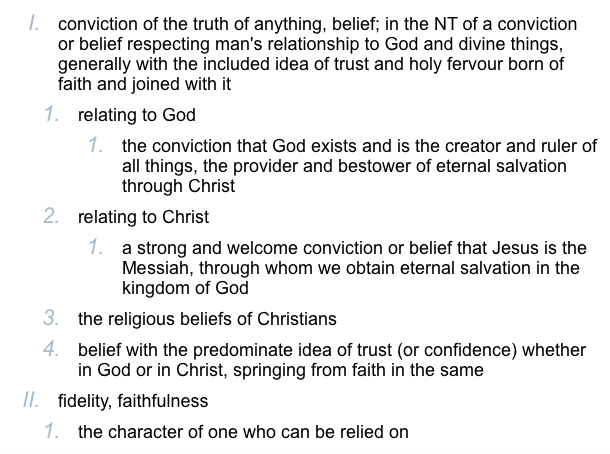
The Greek word translated faith is defined thusly:

https://www.blueletterbible.org/lexicon/g4102/kjv/tr/0-2/#lexResults

  1. conviction of the truth of anything, belief; in the NT of a conviction or belief respecting man's relationship to God and divine things, generally with the included idea of trust and holy fervour born of faith and joined with it

    1. relating to God

      1. the conviction that God exists and is the creator and ruler of all things, the provider and bestower of eternal salvation through Christ

    2. relating to Christ

      1. a strong and welcome conviction or belief that Jesus is the Messiah, through whom we obtain eternal salvation in the kingdom of God

    3. the religious beliefs of Christians

    4. belief with the predominate idea of trust (or confidence) whether in God or in Christ, springing from faith in the same

  2. fidelity, faithfulness

    1. the character of one who can be relied on

This word, pistis, does not mean bare intellectual assent but such assent joined to it with "trust and holy fervour."

As regards Christ it means "a strong and welcome conviction or belief that Jesus is the Messiah, through whom we obtain eternal salvation." 

Yet as seen in the Confession of Dositheus this notion is "far from all Orthodoxy." Thus Eastern Orthodoxy  rejects the biblical definition of faith for a bare "right notion that is in us concerning God and divine things." No matter how you slice it the Eastern Orthodoxy Church officially, confessionally, and canonically rejects the Gospel which tells us we are saved by faith in Christ meaning not only right belief but also "trust and holy fervor" in the righteousness of Jesus Christ. 

Saturday, 20 July 2024

The Confession of Dositheus Remains Authoritative

I was engaging with Orthodox believers on Twitter about the Confession of Dositheus and its prohibition on reading the Bible when someone claimed that parts of the Confession had actually been repudiated by various synods. 

https://twitter.com/JYLewis3/status/1733632063470018592

Parts of it were repudiated in later synods doesn't mean we throw everything out. It was too westernized in language. Fr. Trenham is great. He is not authoritative.
I asked him which synods repudiated parts of the Confession of Dositheus and was promptly blocked. That is par for the course for Orthobros. He also commented that the Confession of Dositheus is not "completely authoritative."

https://twitter.com/JYLewis3/status/1733625463866847372

Also per Trisgonfilms if you email them they will break it down. It isn't even completely authoritative. We don't blindly read councils and confessions etc. Outside the interpretative lens of the church.
Blindly reading scripture without spiritual guidance can be unadvisable

The fact is he is wrong. The Confession of Dositheus is both authoritative and normative. There have been no synods which have repudiated a single word of the confession. This is attested to by Michael Pomazansky in his book Orthodox Dogmatics.

The interpretations of the Symbol of Faith, or the "Symbolic Guides" (from the Greek symballo, meaning "to unite;" symbolon, a uniting or conditional sign) of the Orthodox Faith, in the common meaning of this term, are those expositions of Christian faith which are given in the Book of Canons of the Holy Apostles, the Holy Local and Ecumenical Councils, and the Holy Fathers. The theology of the Russian Church also makes use, as symbolical books, of those two expositions of the Faith which in more recent times were evoked by the need to present the Orthodox Christian teaching against the teaching of the unorthodox confessions of the second millennium. These books are: The Confession of the Orthodox Faith compiled by the Patriarch of Jerusalem, Dositheus, which was read and approved at the Council of Jerusalem in 1672 and, fifty years later, in answer to the inquiry received from the Anglican Church, was sent to that church in the name of all the Eastern Patriarchs and is therefore more widely known under the name of "The Encyclical of the Eastern Patriarchs on the Orthodox Faith." 

http://www.holytrinitymission.org/books/english/dogmatics_pomazansky.htm

Here he notes that the Confession is a symbolical book which presents an Orthodox exposition of the faith against unorthodox confessions. 

In a catechism published in 2006 His Eminence Panteleimon Lampadario notes that the Confession of Dositheus embodies Apostolic Tradition.  

Question 15: What sources embodied Apostolic Tradition?

Answer: The oral and living Teachings of the Holy Apostles that were passed down by word of mouth, began to differentiate from Holy Scripture during the second century. This comprised the Apostolic Tradition that was recorded and embodied within:

(a) The official interpretations of Scripture.
(b) The Symbols or Confessions of Faith. The interpretations of the Symbol of Faith of the Orthodox Church, in the common meaning of this term, are those expositions of the Christian Faith which are given in the:

1 - Books of Canons of the Holy Apostles.
2 - The Holy Local and Ecumenical Councils.
3 - The Holy Fathers.
4 - The Confession of the Orthodox Faith, compiled by Dositheus, Patriarch of Jerusalem in 1672.
5 - The Encyclical of the Eastern Patriarchs on the Orthodox Faith, compiled by Dositheus, Patriarch of Jerusalem in 1732.

https://drive.google.com/file/d/1MJAhPmagwm2jji1x86Es3fRCuvg3Ctzm/view?pli=1

Along with Pomazansky His Eminence Panteleimon Lampadario also calls the Confession of Dositheus an exposition of the Christian Faith. 

Likewise, Bishop Kallistos Ware lists the confession amongst the Chief Orthodox Doctrinal Statements. 

While the doctrinal decisions of general councils are infallible, those of a local council or an individual bishop are always liable to error; but if such decisions are accepted by the rest of the Church, then they come to acquire Ecumenical authority (i.e. a universal authority similar to that possessed by the doctrinal statements of an Ecumenical Council). The doctrinal decisions of an Ecumenical Council cannot be revised or corrected, but must be accepted in their entirety; but the Church has often been selective in its treatment of the acts of local councils: in the case of the seventeenth-century councils, for example, their statements of faith have in part been received by the whole Orthodox Church, but in part set aside or corrected.

The following are the chief Orthodox doctrinal statements since 787:

  1. The Encyclical Letter of St Photius (867).

  2. The First Letter of Michael Cerularius to Peter of Antioch (1054).

  3. The decisions of the Councils of Constantinople in 1341 and 1351 on the Hesychast Controversy. The Encyclical Letter of St Mark of Ephesus (1440 – 1).

  4. The Confession of Faith by Gennadius, Patriarch of Constantinople (1455 – 6).

  5. The Replies of Jeremias II to the Lutherans (1573 – 81).

  6. The Confession of Faith by Metrophanes Kritopoulos (1625).

  7. The Orthodox Confession by Peter of Moghila, in its revised form (ratified by the Council of Jassy, 1642).

  8. The Confession of Dositheus (ratified by the Council of Jerusalem, 1672).

  9. The Answers of the Orthodox Patriarchs to the Non-Jurors (1718,1723).

  10. The Reply of the Orthodox Patriarchs to Pope Pius IX (1848).

  11. The Reply of the Synod of Constantinople to Pope Leo XIII (1895).

  12.The Encyclical Letters by the Patriarchate of Constantinople on Christian unity and on  the ‘Ecumenical Movement' (1920, 1952).

The Orthodox Church, pg. 197.

Note that Ware writes "in the case of the seventeenth-century councils, for example, their statements of faith have in part been received by the whole Orthodox Church, but in part set aside or corrected." That would include the Confession of Dositheus but he does not indicate anywhere in his book that any section of that confession has been set aside or corrected.

If the Confession of Dositheus is a faithful exposition of Orthodoxy how could any of it be repudiated? By default it would have to be accepted by everyone. To repudiate it means the Council of Jerusalem which ratified it gave their approval to a document which does not accurately convey Orthodox beliefs. 

Thursday, 18 July 2024

Benjamin Langlois is Wrong About St. Basil's Remarks on Tradition

David Patrick Harry, known as Church of the Eternal Logos, recently had a guest on his show named Benjamin Langlois, also known as Orthodox Luigi, to talk about Orthodoxy. The conversation compared Catholicism and Protestantism to Orthodoxy which led Benjamin to say something interesting. 


1:26:30 It's like in my debate with Redeemed Zoomer right when he would quote St Irenaeus or St Athanathius or whoever. It's like all I have to do is go to this other quote, right, where they obviously, like, he tried to quote St Basil right and I'm so glad he did because I had that quote that explicitly says that there are things that are part of the Gospel that aren't in scripture.
What's interesting about this is that it's not true. St. Basil does write about tradition but never says "there are things that are part of the Gospel that aren't in Scripture." Here is the full quote from St. Basil's work On the Holy Spirit.
66. Of the beliefs and practices whether generally accepted or publicly enjoined which are preserved in the Church some we possess derived from written teaching; others we have received delivered to us in a mystery by the tradition of the apostles; and both of these in relation to true religion have the same force. And these no one will gainsay — no one, at all events, who is even moderately versed in the institutions of the Church. For were we to attempt to reject such customs as have no written authority, on the ground that the importance they possess is small, we should unintentionally injure the Gospel in its very vitals; or, rather, should make our public definition a mere phrase and nothing more. For instance, to take the first and most general example, who is thence who has taught us in writing to sign with the sign of the cross those who have trusted in the name of our Lord Jesus Christ? What writing has taught us to turn to the East at the prayer? Which of the saints has left us in writing the words of the invocation at the displaying of the bread of the Eucharist and the cup of blessing? For we are not, as is well known, content with what the apostle or the Gospel has recorded, but both in preface and conclusion we add other words as being of great importance to the validity of the ministry, and these we derive from unwritten teaching. Moreover we bless the water of baptism and the oil of the chrism, and besides this the catechumen who is being baptized. On what written authority do we do this? Is not our authority silent and mystical tradition? Nay, by what written word is the anointing of oil itself taught? And whence comes the custom of baptizing thrice? And as to the other customs of baptism from what Scripture do we derive the renunciation of Satan and his angels? Does not this come from that unpublished and secret teaching which our fathers guarded in a silence out of the reach of curious meddling and inquisitive investigation?
Basil says if we reject the customs handed down to us "we should unintentionally injure the Gospel in its very vitals." He then explains himself by saying "or, rather, should make our public definition a mere phrase and nothing more." St. Basil is not saying "there are things that are part of the Gospel that aren't in scripture." These traditions and customs are not part of the Gospel they are part of public worship.

These traditions include making the sign of the cross, facing East while praying, the words of invocation over the Eucharist, words of blessing for oil and baptismal water, and triple immersion. None of those things is part of the Gospel. They are expression of worship. 

Paul defined the Gospel in 1 Corinthians 15:
1 Moreover, brethren, I declare unto you the gospel which I preached unto you, which also ye have received, and wherein ye stand;

2 By which also ye are saved, if ye keep in memory what I preached unto you, unless ye have believed in vain.

3 For I delivered unto you first of all that which I also received, how that Christ died for our sins according to the scriptures;

4 And that he was buried, and that he rose again the third day according to the scriptures:

5 And that he was seen of Cephas, then of the twelve:

6 After that, he was seen of above five hundred brethren at once; of whom the greater part remain unto this present, but some are fallen asleep.

7 After that, he was seen of James; then of all the apostles.

8 And last of all he was seen of me also, as of one born out of due time.

9 For I am the least of the apostles, that am not meet to be called an apostle, because I persecuted the church of God.
Notice how Paul says the Gospel is written in the Scriptures. He does not appeal to "silent and mystical tradition" to define the Gospel but to the Scriptures. Jesus does the same thing in Luke 24.
25 Then he said unto them, O fools, and slow of heart to believe all that the prophets have spoken:

26 Ought not Christ to have suffered these things, and to enter into his glory?

27 And beginning at Moses and all the prophets, he expounded unto them in all the scriptures the things concerning himself.
The Gospel, ALL of the Gospel, is contained in the Scriptures.

What is interesting about Benjamin's comment is that it says a lot about him. He converted to Orthodoxy from Protestantism and posted the following comments on Instagram.

When Jesus Christ ascended unto heaven, He didn't leave a Bible, He left a Church.

What about the Scriptures? The Scriptures themselves were given to us through the Church. For the first several hundred years of Church History, there was no closed canon of Scripture. Scripture, which is the ultimate form of Apostolic Tradition, was preserved in the Church.  
Both of those statements are misleading and wrong. Jesus Christ certainly did leave a Bible when he ascended. In fact when he was born the Bible already existed. It is He who inspired it's words and it is He who is its subject. The entirety of the Old Testament proclaims Jesus Christ as He Himself proved in Luke 24 when "beginning at Moses and all the prophets, he expounded unto them in all the scriptures the things concerning himself."

The second comment is a non sequitur. There was no closed canon of scripture therefore...what? Sola Scriptura is wrong? That is the implication yet that is certainly not the reality. Sola Scriptura: 
affirms that Scripture is to be understood as the sole source of divine revelation, the only inspired, infallible, final, and authoritative norm of faith and practice
Echoing that sentiment Irenaeus, writing in the second century, says the Scriptures are the "ground and pillar of our faith."
We have learned from none others the plan of our salvation, than from those through whom the Gospel has come down to us, which they did at one time proclaim in public, and, at a later period, by the will of God, handed down to us in the Scriptures, to be the ground and pillar of our faith 
Irenaeus, Against Heresies 3.1.1 
Likewise Ben's claim that there was no closed canon of Scripture for several hundred years means nothing. He should read Lee McDonald's "The Biblical Canon." In this book are various canonical lists which do not all agree. McDonald on pages 216 and 217 writes the following:

There is little doubt that the core of the biblical collection of authoritative books is essentially the same collection that we no have int he Protestant OT collection. What is in question in canonical studies are book on the fringe. These fringe books included both canonical and apocryphal books, were disputed among Jews and Christians for centuries, even though many leaders in the church and synagogue freely quoted these writings in an authoritative manner, sometimes even using the designations Scripture or as it is written to refer to them. Remarkably, these disputes took place for centuries after decisions were supposedly made about its canonicity. Yet in neither group - those who accepted and those who rejected the authority of this literature - was there any noticeable change in theology.
“The decision whether to accept or reject the deuterocanonical literature is not at the core of what Christianity is all about. As the Law of Moses formed the core of the OT, so also the Gospels and Paul have been at the heart of the NT biblical canon since the second century, even though there was a great deal of dispute over the deutero-Pauline epistles (especially the Pastorals), Hebrews, the Catholic (or General) Epistles, and Revelation. The Jews and later the Christians fully accepted the Law of Moses as the core of their sacred Scriptures. Soon thereafter, most if not all of the traditional Prophets and many of the Writings were accepted as canonical, but at a secondary level of scriptural authority among the Jews. Not everyone agreed on the contents of the Writings, especially not before the time of Jesus, but the division of opinion was not over the core, but over the fringe.
The issue, writes McDonald, is fringe books and not the core. There has always been a core of canonical scripture for both Christians and Jews. At first the Christians adopted the Septuagint. Later they held the Gospels and the letters of Paul to be central to their doctrines. The very fact that there are lists at all indicates that Scripture was being appealed to as an authoritative source of doctrine.

Contrary to Protestants and even Catholics the Orthodox actually forbid the laity from reading the Scriptures. This prohibition is found in The Confession of Dositheus. 

Should the Divine Scriptures be read in the vulgar tongue [common language] by all Christians? 

No. Because all Scripture is divinely-inspired and profitable {cf. 2 Timothy 3:16}, we know, and necessarily so, that without [Scripture] it is impossible to be Orthodox at all. Nevertheless they should not be read by all, but only by those who with fitting research have inquired into the deep things of the Spirit, and who know in what manner the Divine Scriptures ought to be searched, and taught, and finally read. But to those who are not so disciplined, or who cannot distinguish, or who understand only literally, or in any other way contrary to Orthodoxy what is contained in the Scriptures, the Catholic Church, knowing by experience the damage that can cause, forbids them to read [Scripture]. Indeed, tt is permitted to every Orthodox to hear the Scriptures, that he may believe with the heart unto righteousness, and confess with the mouth unto salvation {Romans 10:10}. But to read some parts of the Scriptures, and especially of the Old [Testament], is forbidden for these and other similar reasons. For it is the same thing to prohibit undisciplined persons from reading all the Sacred Scriptures, as to require infants to abstain from strong meats.

Benjamin is simply wrong about the Scriptures and about St. Basil. 

Towards the end of the video David Patrick Harry says:
2:48:26 So, this is something I, I've done with one-on-ones, with young guys who, you know, go down the Ortho rabbit hole. They know all the theology, Church history, and I'm like well, ok, what parish do you go to? Oh, I haven't gone to a Church yet. It's like, why you tell, you're telling me you're Orthodox, what are you talking about? This isn't a belief system. This isn't an ideology this is a lived experience and so it's like, bro, that I'm really happy you've read all these books, um, but, go to a damn parish dude. Like, what are you doing?
Now, David did not mean to call the Orthodox Church damned but how is any Church which denies the right of the laity to read the Scriptures not damned?