Saturday, 13 July 2024

Father Stephen De Young Does not Know What Was in the Ark of the Covenant

What was in the Ark of the Covenant? Easy question answered by the Bible. 


and the ark of the covenant overlaid round about with gold, WHEREIN WAS the golden pot that had manna, and Aaron's rod that budded, and the tables of the covenant

It can't get any clearer that the pot of manna, Aaron's rod, and the tables of the covenant were inside the ark. All three of those items follow the words WHERE IN WAS which means that's where they were. Father Stephen De Young says this is an urban legend. 

Verse 4, “which had the golden censer and the ark of the covenant overlaid on all sides with gold, in which,” that in which is… Okay, so I’m going to pause a second. Pet peeve urban legend. The pot with the manna and Aaron’s rod that budded were not in the ark. People think they were in the ark. They’re not in the ark, if you read carefully. They were put into the Holy of Holies along with the ark, whereas the The Tablets of the Torah were  inside the ark. But those are the things that were back in there in the holy of Holies.

https://www.ancientfaith.com/podcasts/wholecounsel/hebrews_91_28/

This is wrong. The description of the contents of the Holy of Holies are the golden censer and the ark. Then the contents of the ark are described which include the pot of manna, Aaron's rod, and the stone tablets.  Even the notes in the Orthodox Study Bible say that.

9:4 The ark of the covenant contained the relics, as it were, of Israel: the pot of manna, Aaron's rod, and the tablets of the Law.

Are the editors of the Orthodox Study Bible perpetuating an urban legend? Is that what Father Stephen de Young, who is Orthodox, is willing to say? Of course they are not. Father de Young is misreading the scriptures which are grammatically clear.

But there is more.

When discussing the actions of the priest inside the Holy of Holies, the offering up of blood as an atonement, Father de Young denies he is offering it at all. He is merely smearing it on various objects. 

Verse seven, “But into the second part the high priest went alone once a year, not without blood, which he offered for himself and for the people’s sins committed in ignorance; the Holy Spirit indicating this, that the way into the Holiest of All was not yet made manifest while the first tabernacle was still standing.” So noone could go in there except that one day, and then they tied a rope to him in case he dropped dead and all that. But also, he had to, when you read the day of atonement ritual, he had to go in and set up this huge cloud of incense, because that was the day on which Yahweh the god of Israel would appear in the holy place. And if he saw him, he would die, so he had to set up this huge cloud of incense so he wouldn’t see him.

And he had to come in with the blood that he had to smear everywhere to cleanse and purify everything. Now remember, we’ve been taught to think “blood for the blood god,” he comes in and he offers the blood — God is drinking the blood or something — which is not it at all. What did he do with the blood on the day of atonement? He went in and he smeared it on the physical objects, on the furniture, on all these things that were these golden things that were just named, to purify them from the residue of the sins of the people.

https://www.ancientfaith.com/podcasts/wholecounsel/hebrews_91_28/

Father de Young reads verse seven which says the High Priest went into the Holy of Holies to offer blood. Then Father de young says he didn't really offer blood at all. Instead he smeared it on the objects inside the Holy of Holies to purify those objects "from the residue of the sins of the people." Objects need to be purified from the sins of the people? No. The blood is offered for the people's sins.

The blood is also not smeared everywhere but is sprinkled on the mercy seat. Of course Father de Young mocks the idea of the mercy seat.

But comment on that mercy seat: our friends the King James translators invented that whole idea, I’m guessing because their misread of the idea— So God wasn’t enthroned on the ark. The ark was the footstool of his throne. But they’re trying to translate kefir verbs in Hebrew, hilastērion in Greek, which is the word that we translate as atonement. And they come up with mercy seat for the top of the ark. So here’s the thing: kefir verbs literally mean— like Yom Kippur, the Kippur in Yom Kippur, Yom is day, Kippur is atonement— but the root meaning of those verbs is “to cover.” Like, to cover something over. So when that word is used to describe the lid of the ark of the covenant, it just means the cover. Like the lid, the cover, the cover of a book. Mercy seat is going way out of your way!

God was not enthroned on the ark? Again Father de Young contradicts the Orthodox Study Bible which says just the opposite.

https://archive.org/details/the-orthodox-study-bible-2021-medium-quality-scan/page/1663/mode/2up

God is enthroned upon the cherubim; hence, God's throne in Israel's midst, the mercy seat, has a cherub on each side (the Orthodox Christian altar is flanked by cherubim). These representations, along with the pictures of cherubim on the inner veil (Ex 26:31) and the beauty and detailed workmanship of everything made for the tabernacle, serve as the icons of the OT. This, and numerous other passages, held put to rest the fear that the Second Commandment (Ex 20:4-6) prohibits all imagery. God cannot be represented because divine nature is unknowable and hence cannot be depicted, However, when the Son becomes Man, the human nature of God the Son can be and is, imaged, 

Will Father De Young be so bold as to say the Orthodox Study Bible is wrong? 

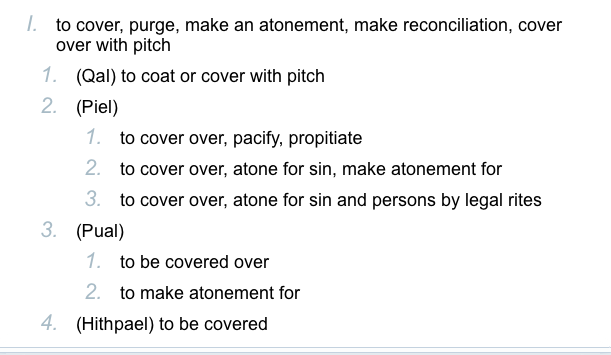
How about his Greek and Hebrew? He says that the root word for the Greek word translated "mercy seat" and the Hebrew word "kippur" means to cover. You know, like the cover of a book. What a base way to degrade the atonement. Apparently the blood of Christ atones for our sins in the way one covers a book or places a lid on the cookie jar! A quick look at those words shows he is wrong. 

Greek:
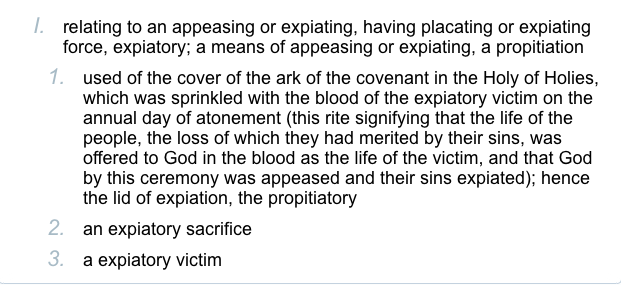
https://www.blueletterbible.org/lexicon/g2435/kjv/tr/0-1/

relating to an appeasing or expiating, having placating or expiating force, expiatory; a means of appeasing or expiating, a propitiation
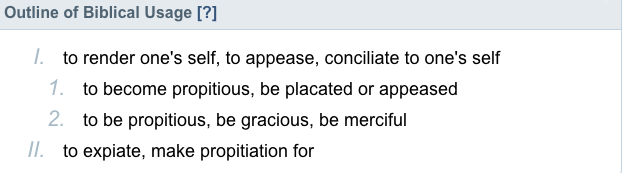

Root:

to render one's self, to appease, conciliate to one's self
  1. to render one's self, to appease, conciliate to one's self

    1. to become propitious, be placated or appeased

    2. to be propitious, be gracious, be merciful

  2. to expiate, make propitiation for


Hebrew:

  1. to cover, purge, make an atonement, make reconciliation, cover over with pitch

    1. (Qal) to coat or cover with pitch

    2. (Piel)

      1. to cover over, pacify, propitiate

      2. to cover over, atone for sin, make atonement for

      3. to cover over, atone for sin and persons by legal rites

    3. (Pual)

      1. to be covered over

      2. to make atonement for

    4. (Hithpael) to be covered

The root of this word is not given but look at that! The usage of cover here has NOTHING to do with covering a book. It has to do with pacification, propitiation, and atonement. 

Here is Father de Young and Father Stephen Damick denying blood was offered to God.

Fr. Stephen: It usually wasn’t applied to people, but, yes, in those other cases the blood was seen as this cleansing and purifying agent. It was never offered to anybody in Israelite religion. It was never offered to anybody, it was not used to pay for anything, it was not “blood for the blood god”—you’ve got to go to Mesoamerica to get that. It was either disposed of in the sacred way or used for the purpose of cleansing and purification.

Fr. Andrew: Yeah, not… You don’t put it on the table and eat and drink it with your God—unless you’re a pagan.

Fr. Stephen: Or offer it to him in any other way.

https://www.ancientfaith.com/podcasts/lordofspirits/the_sacrifices_of_righteousness/

Except the Hebrews chapter 9 says the blood was offered to God by the High Priest. Blood is REQUIRED for atonement.

Leviticus 17:11 For the life of the flesh is in the blood: and I have givenit to you upon the altar to make an atonement for your souls: for it is the blood that maketh an atonement for the soul.

If blood was not offered to God by the High Priest then what of the blood of our High Priest Jesus Christ? Was that just smeared on the cross? No it was offered up to God. 

Hebrews 9:13-14 For if the blood of bulls and of goats, and the ashes of an heifer sprinkling the unclean, sanctifieth to the purifying of the flesh:

How much more shall the blood of Christ, who throughthe eternal Spirit offered himself without spot to God, purge your conscience from dead works to serve the living God?

Hebrews 9:22 And almost all things are by the law purged with blood;and without shedding of blood is no remission.

It is simply mystifying how these Orthodox priests can teach the opposite of what is in the Orthodox Study Bible and how they can mock the blood offering of the High Priest by saying "it was not blood for the blood god" and it was not offered to Him in anyway. Every Sunday these men transform wine into blood which the people drink!

The fact is Orthodoxy over all has a large problem with Penal Substitution and the blood atonement of Jesus Christ. But that is an article for another day. 

Tuesday, 4 June 2024

St Augustine: The Helplessness of Infancy is Punishment For Sin

In Book one, Chapter 68 of On the Merits and Forgiveness of Sins and on the Baptism of Infants St. Augustine posits that the prolonged helplessness of infancy is a penal result of Adam's fall. Had Adam not sinned perhaps infants would have grown much quicker. Augustine also compares the sustained helplessness of infants with the quick growth of animals. 

The question which we are now discussing is not about Adam in respect of the size of his body, why he was not made an infant but in the perfect greatness of his members. It may indeed be said that the beasts were thus created likewise — nor was it owing to their sin that their young were born small. Why all this came to pass we are not now asking. But the question before us has regard to the vigor of man's mind and his use of reason, by virtue of which Adam was capable of instruction, and could apprehend God's precept and the law of His commandment, and could easily keep it if he would; whereas man is now born in such a state as to be utterly incapable of doing so, owing to his dreadful ignorance and weakness, not indeed of body, but of mind — although we must all admit that in every infant there exists a rational soul of the self-same substance (and no other) as that which belonged to the first man. Still this great infirmity of the flesh, clearly, in my opinion, points to a something, whatever it may be, that is penal. It raises the doubt whether, if the first human beings had not sinned, they would have had children who could use neither tongue, nor hands, nor feet. That they should be born children was perhaps necessary, on account of the limited capacity of the womb. But, at the same time, it does not follow, because a rib is a small part of a man's body, that God made an infant wife for the man, and then built her up into a woman. In like manner, God's almighty power was competent to make her children also, as soon as born, grown up at once.

But not to dwell on this, that was at least possible to them which has actually happened to many animals, the young of which are born small, and do not advance in mind (since they have no rational soul) as their bodies grow larger, and yet, even when most diminutive, run about, and recognize their mothers, and require no external help or care when they want to suck, but with remarkable ease discover their mothers' breasts themselves, although these are concealed from ordinary sight. A human being, on the contrary, at his birth is furnished neither with feet fit for walking, nor with hands able even to scratch; and unless their lips were actually applied to the breast by the mother, they would not know where to find it; and even when close to the nipple, they would, notwithstanding their desire for food, be more able to cry than to suck. This utter helplessness of body thus fits in with their infirmity of mind; nor would Christ's flesh have been in the likeness of sinful flesh, unless that sinful flesh had been such that the rational soul is oppressed by it in the way we have described — whether this too has been derived from parents, or created in each case for the individual separately, or inspired from above — concerning which I forbear from inquiring now.

https://www.newadvent.org/fathers/15011.htm

Friday, 24 May 2024

Father Peter Heers Declares: "God Did Not Create Hell"

Father Peter Heers was recently on a podcast with David Patrick Harry discussing end time prophecies made by various Orthodox Church Fathers. During this discussion he declared that God did not create hell.

End Time Prophecy and Orthodox Eschatology with Fr. Peter Heers 

47:21 People will freely choose the Antichrist. They freely choose to go to hell too. Nobody's in hell that doesn't want to be in hell. 

Right 

Nobody's sent by by God to Hell. God didn't create hell. 

Nobody is sent by God to hell and God did not create hell? Really? Let us hear the words of Jesus Christ. 

Matthew 25:21 Then shall he say also unto them on the left hand, Depart from me, ye cursed, into everlasting fire, prepared for the devil and his angels:

Jesus says the everlasting fire, that is hell, was prepared for the devil and his angels. He also says the Kingdom was prepared for the saints.

Matthew 25:34 Then shall the King say unto them on his right hand, Come, ye blessed of my Father, inherit the kingdom prepared for you from the foundation of the world:

Was the Kingdom created by God? Surely Fr. Heers would say yes. So what is his problem with God creating hell? Does Hell exist? Yes. Is there anything that exists that was not created by God? No. Therefore God created hell.

Everything that ever was or is or will be is created by God, including hell (Colossians 1:16). John 1:3 says, “All things were made through him, and without him was not anything made that was made.” God alone has the power to cast someone into hell (Luke 12:5). Jesus holds the keys of death and Hades (Revelation 1:18).

Jesus said that hell was “prepared” for Satan and the demons (Matthew 25:41). It is a just punishment for the wicked one. Hell, or the lake of fire, will also be the destination for those who reject Christ (2 Peter 2:4–9). 

https://www.gotquestions.org/did-God-create-hell.html

While it may be true in a sense that we choose hell by our actions it is also true God weighs those actions and casts all those not found in the Book of Life into hell along with the devil.

Revelation 20:15 And whosoever was not found written in the book of life was cast into the lake of fire.

Did they cast themselves? Did they run and jump into the Lake of Fire? No. God sent them there. He cast them into the flames. Therefore God sends people to hell. 

The problem here is that despite 2,000 years of teaching the Orthodox Church, for some reason, does not have a coherent eschatology. In fact their eschatology is completely divorced from the Scriptures and wholly reliant on what men like St. Issac the Syrian have to say. Thus there are "hopeful" universalists, there are believers in aerial toll-houses, and there are some who think hell is simply experiencing God's presence negatively alongside the saints who experience it positively. That final view is known as the River of Fire and it's a good bet Fr. Peter Heers believes that heresy. 

Here is Orthodox writer Vladimir Moss refuting that abominable teaching which essentially denies that God is just and God punishes. 

https://www.orthodoxchristianbooks.com/articles/837/-river-fire-revisited/

Sadly too many modern Orthodox, including David Patrick Harry, Jay Dyer, and Father Seraphim Rose, have been hoodwinked by this heresy and other eschatological heresies including aerial toll-houses.  

Monday, 15 April 2024

Jay Dyer Falsely Claims Protestants Do Not Make a Difference Between the Holy and the Profane

It is simply amazing how Jay Dyer consistently lies about Protestantism. Let's listen in on his latest lie. 


NALA, KNOWLES, YE & Cussin! BUSINESS CHURCH: Y U JUDGIN'?? Ain't NOBODY GOT WISDOM! -Jay Dyer

1:04:05 For example in the Orthodox world you if you want to convert there is a period of time. It's not like Billy Graham's thing where he invites you down the Altar and gives you hot slices of chis pza. "Come down the altar we've got hot cheese pizza, I'll give you a slice of pizza and some Cocola if you pray the Jesus pray with me." No it's not like that you don't become a Baptist overnight and, uh, everything's cool, right, cuz you said a sinner's prayer. No. there's a period to see if after 6 months, a year, or three years, or two years that's actually the life that you want to live and the the path you want to take because there's requirements. That's the thing. But this kind of Christianity basically has no requirements except whatever you performatively display to the public. That's it. 

It's that simple. Does that make sense? And don't you see that there's a reason why there's a barrier to these kinds of things? Why is this? Because what Protestantism whether intentionally or inadvertently, what Protestantism lost is this idea of boundaries, this idea of the Holy and the profane. So, we say for example the Holy things are for the holy that means that you have to be in a pure State, confession, etc before you take the Eucharist, before you attend the Lord's Supper. However, outside of Protestantism which lost this notion of dividing the Holy things from the unholy there's no Holy objects, there's no Holy water, there's no Holy images. There's just a Holy book which is a propositional sort of rationalist faith of just worshiping a book.

Now, these words were said within the context of a video where Jay is mocking modern day evangelicalism. Has he forgotten that modern day evangelicalism is basically a creation of the Rockefellers and the World Council of Churches? He has mentioned that many times on his show. 

But not all Protestant Churches have been infected with that disease. This especially concerns the Reformed who most definitely make a difference between the Holy and the profane. They do not engage in circus antics or emotionalism but stick to a traditional liturgy with the focus being the preaching of the Word. 

And not just anyone can join either. One must go through a period of cathecism before one becomes a member and can partake of the Lord's Supper. That Jay fails to make this distinction between Liberal Protestant churches and Conservative Protestant Churches who still follow the creeds and instead groups them all together is a total misrepresentation of the facts and thus a lie. 

It is also not true that the only Holy thing these churches hold to is the Bible, or as Jay so derisively says:

There's just a Holy book which is a propositional sort of rationalist faith of just worshiping a book.

Is he that ignorant of how Protestants view the Lord's Supper? It is also not true that Protestantism is totally rationalist. There is no space to go into that here but for him to say that and deny the mystical elements of Protestantism, i.e. the Lord's Supper, is another lie. Protestants DO NOT WORSHIP the Bible. 

It is insane that Jay continues to make these kinds of intentional misrepresentations and lies but here we are. 

Wednesday, 27 March 2024

Testament: The Story of Moses Review - A Crime Against The Word of God

Netflix has a new three part series about the life of Moses called Testament: The Story of Moses. It blends reenactments with commentary from scholars associated with Judaism, Christianity, and Islam. That in and of itself is very bad because we don't get a real sense of who Moses is and what he really means as he is not the same man to each faith. But that is just a small part of why this series is a steaming pile of donkey manure. 

Let me give two reasons why this new series is worse than Cleopatra. While Cleopatra was awful historical revisionism the danger here is that Netflix is messing with sacred history. 

1. It's too short.

This series is hardly about the LIFE of Moses. It is basically The Ten Commandments and then at the end it skips to his death on Mt. Nebo. It could have been either longer or a lot of the reenactment cut altogether to make room for a fuller story. But thank goodness they opted for neither because what Netflix did with the material they have is utterly atrocious. 

2. The series deviates considerably from the Bible.

Because the producers have Jewish and Islamic scholars giving commentary stories from the Quran and the Midrash are included. That means we learn about Moses having to give a secret code word to Serah Bat Asher, a woman hundreds of years old who came into Egypt with Jacob, to prove he is indeed God's chosen prophet. She hears the magic phrase and sings praises to God and that's how the Israelites knew Moses was legit. 

However, for some reason the producers decided to change much of what is in the scripture and girlboss it up. That means ALL THE WOMEN have faith and ALL THE MEN are faithless. Take Zipporah. In the Bible Moses saves her and her sisters from a group of men and then opens the well and waters their flock. They then go back to their father Jethro and he hears their story and is astonished they did not invite Moses back. So they retrieve him, he eats dinner, Jethro gives him Zipporah to wife, and he serves him for 40 years. 

In this series Moses stumbles out of the desert and Zipporah allows him to drink water. Then he scares off three bandits. They then take him home to their father who is not very sure about this stranger. Zipporah convinces Jethro to allow Moses to tend his sheep. A few months later Zipporah brings Moses food in the desert and sees he has carved Egyptian hieroglyphs into a rock. She asks what it says. He says it's our story. And then they get married. 

There is a lot of nonsense like that scattered all throughout the show. Here is some more:

According to Netflix it was Moses and not God who carved the Ten Commandments into stone.

According to Netflix when the Israelites fought the Amalekites and Moses held his hands up for victory he got tired but he persevered and held them up to the end of the battle. In the Bible he gets tired, sits on a rock, and Aaron and Joshua hold up his hands. 

According to Netflix it was a total surprise to Moses that he was a Hebrew or that he had a brother and sister. 

According to Netflix Moses first met Pharaoh and performed the miracle of turning his staff into a snake at his son's birthday party. Pharaoh is disposed to grant a request on the honor of his son's birthday so Moses says "Let my people go." What is this? The Godfather??

According to Netflix Moses' adoptive Egyptian mother partook of the Passover. Actually that might be in the Midrash. Either way it's not in the Bible but it is in the show.

According to Netflix after Pharaoh and his army were drowned in the Red Sea Miriam alone sang a dirge. In the Bible Miriam and all the women dance with tambourines and sing a song of praise. 

And it goes on and on and on.

There is way too much drama and reenactment and revisionism and not enough about what it all means. Sure there are some platitudes from the commentators but of course there is no hard doctrine. There is also not enough of the Life of Moses. It would have been great to see his wars against the Ethiopians, his marriage to an Ethiopian princess, the wanderings in the wilderness, the building of the Ark and the Tabernacle, and all the rest of the story.  We don't even learn why Moses died outside the promised land. Of course seeing what Netflix did with the little they used I'm glad they did not flub it up even more. 

The whole series is a crime against the Word of God. Any believer of the scriptures cannot take this piece of junk seriously. Stay away. Stay far away.

Jay Dyer Continues to Lie About Sola Scriptura - Claims Protestants Believe the Bible is God!!

Jay Dyer is an ex-Protestant turned Roman Catholic turned Eastern Orthodox. He knows the traditions of all three major branches of the Church. (No, I am not advocating the branch theory here.) Yet for some reason he continues to lie about Sola Scriptura and how Protestants view the Bible saying their doctrine leads to making the Bible God. Let's listen.


Bless God / Ruslan / Gavin Ortlund REFUTED: Sola Scriptura & QNA! -Jay Dyer

47:57 It's just so funny because as you think about this the whole methodology of the Protestant and their whole approach here is literally to make the book God. I mean they actually think that this is God. And that's super duper irony because, number one, it's against their iconoclasm position because if this is God then your God is a creature. And the book is full of images, words. Those are images if you didn't know, they're iconographic. And they're depicting the thing that you say can't be depicted. So, actually you're just a book idolator is all you are even though Jesus said, and he quoted John 10 citing Gavin Ortlund word you know. He cited that where Jesus said "the scriptures cannot be broken." But he also says that You search the scriptures because you think that it is in them that you have eternal life. Oh, but you didn't cite that one did you Ruslan? Did you Gavin? When it is they that bear witness to me.

So, this is like a letter. Imagine mistaking a letter for the person. That's the mistake they're doing here. It's that silly. Right? Somebody writes you a letter about how good of a rapper I am. Now, we all know I'm probably the best. I mean, we all know it's not Lil' AIDS aka Tristana. So, who's left? Me. That's it. Easy equation there. Cancel out the second greatest rapper and you only got one left. So but if somebody writes a big letter explaining how good I am with my vocal bars and skills and you get this letter and you read the letter and you're like "Aww dude I know Jay now. I know all about his freestyle. I know all about his flow cus I read the letter." 

And you're like, "But do you know him?" "Yeah I read the letter, dude." But you don't know me. You read a letter about me. This is how silly it is. 

This video was a livestream and in the comments Rachel Wilson piped up with this ridiculousness:


Rachel Wilson is also a former Protestant of the Dutch Reformed persuasion so she too knows this is a lie yet she says it anyway. Why? Is her book Occult Feminism also this transparently dishonest? 

The short of it is Protestants DO NOT BELIVE THE BIBLE IS GOD. Nor does Sola Scriptura philosophically lead to declaring the Bible is God or worshipping it as an idol. Protestants do not teach the Bible is the Word in exclusion to Jesus Christ. Richard Muller wrote about this issue in the second volume of his Post Reformed Reformed Dogmatics. 

The authority of Scripture rests both on its identity as Word and its inspiration by the Spirit; and, equally so, the unity of the testaments rests both on Christ, who is their scope and foundation, and on the inspiration of the prophets and the apostles by the same Spirit. Scripture is Word because, in its entirety, it rests on the redemptive Word and Wisdom of God finally and fully revealed in Christ. 

Richard Muller is definitely a much needed corrective to Jay and his friend's misconceptions and misrepresentations of the Protestant faith. Having read what appears to be all the primary sources of Reformed theology Muller, in four volumes, deftly weaves together a reassessment of Reformed prolegomena, doctrine of scripture, and doctrine of God and the Trinity that upsets conventional wisdom. 

One of the most important things Muller brings up in his magnum opus is the continuity between the Reformed and the medievals. Anyone who has read medieval and Reformed theology would recognize the similarities they share in the doctrine of God and even predestination. The book "Luther: Right or Wrong" has as it's thesis that Luther's "Bondage of the Will" is not at all out of synch with Aquinas. 

Recognizing the continuities between Reformed theology and Medieval and Patristic theology is just as important, if not even more so, as pointing out the discontinuities. 
The early Reformation view of Scripture, for all that it arose in the midst of conflict with the churchly tradition of the later Middle Ages, stands in strong continuity with the issues raised in the theological debates of the fourteenth and fifteenth centuries. The late medieval debate over tradition and the late medieval and Renaissance approach to the literal sense of the text of Scripture in its original languages had together raised questions over the relationships between Scripture and churchly theology, between the individual exegete and the text, and between the exegete and established doctrine that looked directly toward the issues and problems addressed by the early Reformers. It is, thus, entirely anachronistic to view the sola scriptura of Luther and his contemporaries as a declaration that all of theology ought to be constructed anew, without reference to the church’s tradition of interpretation, by the lonely exegete confronting the naked text. It is equally anachronistic to assume that Scripture functioned for the Reformers like a set of numbered facts or propositions suitable for use as ready-made solutions to any and all questions capable of arising in the course of human history. Both the language of sola scriptura and the actual use of the text of scripture by the Reformers can be explained only in terms of the questions of authority and interpretation posed by the developments of the late fifteenth and early sixteenth centuries. Even so, close study of the actual exegetical results of the Reformers manifests strong interpretive and doctrinal continuities with the exegetical results of the fathers and the medieval doctors.
Elsewhere Jay has acknowledged that the Reformation did not pop out of nowhere but has its roots in the middle ages. It is rather strange then that Jay prefers to focus on discontinuities as if that alone proves his point. 

If anyone can be called a book idolator it would be the Orthodox who parade it around the sanctuary, smoke it with incense, and kiss it. 

https://holytrinity.ia.goarch.org/our-faith/liturgy

Now, there is a lot that could be written about Sola Scriptura but the real question here is why does Jay Dyer continue to lie about Sola Scriptura and Protestantism in general? When discussing Protestantism I have yet to hear Jay discuss the confessions and what Protestants actually believe. But he is quick to cite silly evangelicals and make false philosophical extrapolations like saying Sola Scriptura makes the Bible God. 

One wonders if Jay will ever discuss Protestantism or even Eastern Orthodoxy, he has yet to talk about the Confession of Dositheus, in an honest manner. 

Sunday, 24 March 2024

Greg Bahnsen's Review of David Chilton's Days of Vengeance

I have been listening to an audiobook version of David Chilton's commentary on Revelation, Days of Vengeance recntly. While it is an interesting commentary from a partial-preterist perspective it fails because Revelation was written at a late date during the time of Domition and not during or before the time of Nero. While looking for reviews I cam across the following review by Greg Bahnsen. 

Bahnsen was Chilton's teacher and though they shared much of the same theology he did not recommend Chilton's commentary. Interestingly enough he says nothing about the erroneous attribution of an early date of Revelation. This review has apparently vanished from the internet and is only available on the web archive. I publish it here for anyone else looking for it. 


Review:  “Another Look at Chilton’s Days of VengeanceJourney 3:2  (March-April, 1988)

By Greg Bahnsen


The revival of Biblical postmillennialism which we are witnessing in our day will be sustained only if it is fueled and fortified by diligent attention to the Scriptures.  That is what makes so noteworthy a major publication of a commentary on the book of Revelation, such as David Chilton’s The Days of Vengeance (Ft. Worth:  Dominion Press, 1987).  The author devotes nearly 600 pages to exposing the text and theology of this “closed book,” and we must appreciate his labors—as well as the generosity of Dr. North in subsidizing them.


Since the study of Revelation is a special interest of mine, I am often asked for a brief evaluation of David Chilton’s commentary.  This issue of Journey affords the opportunity to reply once in writing (saving personal repetition).  Because the author and I are friends, because we share a common eschatological perspective, and because he sat through a year of my sixty-five lectures on Revelation (delivered a decade ago), many assume that his approach to Revelation is something I would commend.  The reviewer in Journey (Nov-Dec 1987) saw it as “sound” biblical interpretation, indeed “a brilliant work.”  Reluctantly, I cannot share either assessment.  Here let me suggest another look.


There are, unquestionably, many encouraging and helpful things about David’s commentary.  First, it is a modern restatement of a preterist and postmillennial interpretation of Revelation.  Second, specific comments on a number of particular verses are accurate and insightful (e.g., 7:10, where the ascription of salvation to the Lamb is contrasted to claims of the Roman state).  Third, in terms of “packaging,” the book is aptly titled, beautifully illustrated, and clearly written.  Nevertheless, the hermeneutical excesses and errors of the commentary will prove far more detrimental to postmillennialism than any of its isolated virtues can redeem.  Consider three fatal flaws.


Interpretive Maximalism


               A commentary on holy Scripture must be appraised, not only for what it concludes (its harmony with the Bible’s system of doctrine), but likewise for the way it handles the word of God (its interpretive method).  This is the cardinal area of offense in Days of Vengeance.  David admits to consciously trying to simulate the hermeneutical style of James Jordan’s designated “interpretive maximalism” (IM).


               IM claims to be in tune with patristic hermeneutics, holding that “everything in Scripture is symbolic.”  Those benefited with “sufficient imagination” can allegedly see the significance in the “literary architecture” of particular Biblical texts—the way the story is told, even its minor details, what its imagery has in common with other stories, the number of times words are repeated, etc. (pp. 36-37).  For instance, because doorposts could be likened to legs, Jordan claims that the passover blood smeared on doorposts corresponds to the blood of circumcision—which in turn is equivalent to the tokens of virginity from the wedding night (I am not kidding; cf. The Law of the Covenant, pp. 82-83, 252-258).  Jordan finds esoteric meaning in the fact that the word “another” is used exactly six times in Judges 17:1-6.  Karl Hubenthal’s book review of Jordan’s commentary on Judges in Journey: May-June, 1987) duly criticized this as allegorizing the text.  Jordan’s “defense” in the Nov-Dec Journey was two-fold:  (1) Cassuto also reasons in this way [so what?], and (2) this was an ancient literary devise.”  Well, the ancient world certainly did sport many heretic, esoteric, and especially allegorical works (e.g., Philo), but I find it strange that Jordan makes the Bible one of them!  IM leaves the interpreter with an unsure game of “guessing” (as the end of Jordan’s letter admits), rather than a confident “Thus saith the Lord.”


               David’s commitment to the imaginative guesswork of IM renders his commentary on Revelation unsound.  Take as one example his treatment of Rev. 7;1-8 (the revealing of the 144,000).  The text says that winds are inhibited from hurting “the earth, the sea, or the trees” (vv. 1, 3).  David mistakenly claims that the change from genitive to accusative case for “tree” in v. 1 is meant to draw “special attention” to that word.  In fact, the change of case simply pertains to the use of the Greek preposition epi: the wind blows “upon” the earth and sea (epi with genitive), but blows “against” the trees (epi with accusative).  What makes this more than an embarrassing error in Greek grammar is the “special attention” David now gives the word “trees.”


               He suggests that, since trees are figures for righteous men elsewhere in Scripture, the protection of trees in Rev. 7:1 symbolizes the protection of God’s people.  The suggestion is open to obvious criticism.  (1) We may not take for granted that figures of speech have the same referent in every Bible occurrence (e.g., both Jesus and Satan are called “lions”; cf. the multiple use of “stars” in Revelation).  Why don’t trees represent the monarchs (Dan. 4:10, 22) or—“maximally”—all of the above?  (2) David’s “maximal interpretation” of Rev. 7:1-3 is plainly arbitrary.  Not only trees, but also “earth and sea,” are there protected.  He tells us elsewhere that the sea symbolizes heathen nations who hate the Lord (pp. 318, 327).  Following his logic, should we infer that Rev. 7 speaks of God protecting not only the righteous (trees), but also the heathen (sea), from judgment?  (Actually, David also takes the sea to represent ethnic Gentiles and the abyss of hell: pp. 251, 317.  Are either being protected from the “wind” of God’s judgment according to Rev. 7:1-3?)


               David’s IM moves from the arbitrary to the outrageous when, in explaining the “seal” placed upon the foreheads of the 144,000 (Rev. 7:3-4), he alludes to the protective marking of Ezekiel 9:4 and claims that it symbolized “the sign of the cross”!  Error is laid upon error to reach this height of imagination.  (1) the philological error (exposed by Fairbairn: Ezek. 9:4 speaks of an indefinite “mark,” not the Hebrew letter tav.  (2) the orthographic error:  if the ancient tav was different from what we recognize today, it was shaped more like an x, not an upright t(cross).  (3) the historical error:  Jews of Ezekiel’s day would have in mind a form or shape associated with Roman crucifixions of a later age.  (4) the hermeneutical error:  there is no legitimate category of “quasi-prophecy”; this is simply Tertullian’s reading something back into the text.  (5) the liturgical error:  the Bible does not condone the “sign of the cross” as having religious (superstitious) significance for Christians anyway.


               Example after example of IM’s “imaginative” approach to biblical interpretation could be given.  The heavenly Woman of Rev. 12 is taken as “astrological symbolism” for zodiacal Virgo, with the sun mid-bodied and the moon under foot, thus pinpointing the birth of Jesus as sundown on September 11, 3 B.C.  Matthew is said to have used three sets of 14 in his genealogy of Jesus because 14 is the numerical value of David’s name.  The “bowls” of Rev. 15:7 are treated as chalices (despite the word being the same as in 5:8 and different from “cup” in 14:10) to make them appear as “negative sacraments.”  These kinds of flaws and misreading make the commentary unreliable for the reader.  Hermeneutical excesses like those of Hal Lindsey (whom David roundly ridicules) are not less serious when they stem from the other end of the eschatological spectrum.  We must all realize that, while creativity is a virtue in an original author, it is a crime in an interpreter.


Pandemonium of Literary Structuring Devices


Has David understood the book of Revelation as a literary whole?  It would not appear so since he cannot decide what kind of structure or outline it follows.  “Maximalizing” his interpretation, he claims (pp. 13-24) that the book is patterned according to all of the following:  (1) a five-part covenant scheme, and (2) the four sets of seven curses in Leviticus 26, and (3) the Olivet Discourse of Matthew 24, and (4) the prophecy of Ezekiel, and (5) the early church’s paschal liturgy!  By no stretch of the imagination does this make literary sense.  The conflicts and complexities would have produced chaos in John’s mind and proved nothing but confusing to his hearers (to whom the book was read).  The way one interprets a text is strongly influenced by the context within which he perceives it, and David has no clear conception (or, alternatively, far too many conceptions) of the literary pattern of Revelation.  In this connection there are also a host of detail mistakes made by David:


(1)     the monumental error is his artificially imposing “the covenantal structure advocated by Ray Sutton (That You May Prosper, Tyler: I.C.E., 1987) upon the text of Revelation like a Procrustean bed.  Sutton’s thesis is anything but convincing.  He holds that the biblical covenant has “five parts” dealing successively with principles” pertaining to (1) transcendence/immanence,  (2) hierarchy, (3) ethics, (4) sanctions, and (5) continuity.  Sutton sees this five-point pattern repeatedly set forth in Scripture like a master principle of organization: allegedly the ten commandments are really two sets of these five “principles” [commands #3 and #8 being the “ethical” portion?], books of the Bible (Deuteronomy, Psalms, Matthew, Romans) follow this same five-point outline, and Biblical teaching on the family, church and state each fall into this same five-point scheme.  But anyone with a modicum of imagination can devise other “ways to cut the cake” (some with “Trinitarian” threes, some with “perfect” sevens, etc.) and then filter Biblical material through the preconceived grid—with an artificiality and adequacy equal to Sutton’s.  You see, Sutton’s five-point outline does not arise inductively from a study of the text of Scripture itself.  Moreover, it is not even clear what each of five “parts” (or principles”) represents in his scheme:  are they literary genres, successive portions of a document, theological topics, specific theological theses, or just what?  Sutton is so vague here that his position is simply untestable.  If the five “principles” are an ordered scheme of specific doctrinal assertions that outline a discourse, they are certainly not repeated as such throughout Scripture even in passages explicitly dealing with the “covenant”); you can be sure somebody before Sutton would have noticed anything that clear.  If they are only vague theological themes which might be touched upon in a wide variety of ways, there is nothing important or unique about Sutton’s five-point scheme.  And to hold that the five-part succession of these broad themes outlines books of the Bible is almost silly—as we see when Sutton makes the whole fourth “part” of Romans to be only two verses in chapter 16!  It is a shame that David tried to squeeze Revelation into this artificial five-part outline.

(2)     But David also has a four-part outline for Revelation!  He finds a pattern of “sevenfold judgment coming four times” in Leviticus 26 and says it is “fully developed” later in Revelation—a lamentable faux pas.  What occurs four times in Lev. 26 is not seven-fold judgment itself, but rather the statement of God that He will punish seven-fold.  But even overlooking that, how can David reconcile his five-part and four-part outlines for Revelation?  Can the same pie be completely divided into four and completely divided into five pieces?  For an advocate of IM, yes!  David claims (pp. 17-18) that John actually “combined” the four-part curse outline and the five-part covenant lawsuit—because, after all, restitution in the law of God is both four-fold and five-fold.  Is that clear?  Well, there is another step.  According to Jordan’s incredible symbolism, four-fold for restitution was for oppressing the poor (Christ as sheep) and five-fold for rebellion against authority (Christ as Lord).  Therefore, to everyone’s surprise, Revelation is actually structured to communicate a combinationof the multiple restitutions in Ex. 22:1 for Jesus in both his capacities as poor and royal.  This is too bizarre to be taken seriously by any literary critic.

(3)     David’s pandemonium of structuring devices leads him into embarrassing contradictions.  (What else would one expect?)  Consider the letters to the seven churches in Rev. 2-3.  One the Lev. 26-pattern, David makes them to be one of the four sets of seven-fold judgment in Revelation.  On the covenant-pattern, David makes them the “historical prologue” part of the covenant document—the statement of gracious blessinghistorically enjoyed by the vassals under the lord of the covenant!  Well, then, how should we interpret Rev. 2-3, as curse or as blessing?  They are hardly the same (theologically or as literary genres).

(4)     Here is another example of an amazing chain of dubious reasoning (pp. 20-24).  Revelation follows Ezekiel “step by step” [as well as Lev. 26 and Matt. 24?].  Such “level pegging” is a feature of lectionary use.  Both Ezekiel and Revelation can be divided into “about fifty units” [fifty? Previously it was five, then four]—which is also about the number of Sabbaths in the years.  Therefore, Revelation was intended for lectionary use as a series of liturgical readings in the church through the year, accompanying the reading of Ezekiel! Even if we forgive the mathematical inaccuracies (52 sabbaths per year) and arbitrariness (why 50 units instead of 40 or 55?), how does it follow from the rough numerical correspondence of literary units to weeks in a year that Revelation is a liturgical lectionary?  This may be suggested by the interpreter’s personal interests and life-setting, but it is not suggested by the text of Revelation itself!  There is quite a logical leap from saying Revelation was read aloud in church (Rev. 1:3, like Colossians, cf. 4:16 to saying it was read as a liturgical lectionary!

(5)     Sadly, David dismisses the book of Revelation’s own internal indicators of how it is structured:  the three-fold outline in 1:19 (past vision, present situation, things to occur hereafter: cf. 4:1) and the literary devise of two prophetic “scrolls”—the seven-sealed scroll about the fall of Israel (5:1ff.) then the small scroll about the fall of the Roman Empire (10:2, 9:11; cf. 13:7).  It is simple, clear, and found inductively.


Misidentification of Key Characters


Finally, any commentary on Revelation which incorrectly interprets major figures in the book cannot be condoned or commended to others.  This is the bottom-line failure of David’s book.  It is a misreading of God’s book.


               For instance, who is “Babylon, the harlot” about whom John “wondered with great wonder” in Rev. 17?  God apparently wanted us to get this right; His angel undertook to “tell the mystery” of the woman (v. 7).  Yet David’s commentary still misses the obvious.  The angel identifies the harlot as “the great city which reigns over the kings of the earth,” a city set on seven hills (17:9, 18); she is the international commercial center of the ancient world (chap. 18).  Given historical context, this is clearly a reference to Rome.  But because David comes to these passages with a preconceived interpretive scheme, he awkwardly tries to make Babylon the harlot out to be Jerusalem!  David’s strange rejoinder to the objection that the description of the harlot-city does not historically fit Jerusalem is that Revelation “is not a book about politics; it is a book about the Covenant” (p. 442).  (David sure gets a lot “about politics” from this book when he wants to!)  But the facts remains that “Covenant” literature does not, as such, justify historical error.  Jerusalem never “reigned over the nations (even given the contrived reference to Ex. 19:6) and certainly was never—even “covenantly”—the principal importer of goods (even slaves) indispensable to the wealth of international merchants (Rev. 18:3, 11, 14:9).  This is a major blunder.


               Similarly, David interprets the “second beast” or “false prophet” who enforces worship of the Emperor (Rev. 13:11-18) as the leaders of Israel, despite the historical inaccuracies involved and with no compelling exegetical argumentation.  This too comes from preconceived interpretive notions.  The second beast is the pagan Emperor-cult itself (pagan ecclesia which stood behind the pagan “polis” or political structure), involving a crass idolatry (13:15) and delegated political power (13:12, 16-17) which were never characteristic of the Jews in Roman era.


               So then, I cannot recommend my friend David’s commentary on Revelation.  (1) It embodies an unsound, imaginative hermeneutic.  (2) It is confused about the book’s structure and meaning.  (3) It is guilty of considerable errors in history and interpretation.


               But then, to be fair, I should alert the reader that the publisher, Dr. North, has already dispensed in advance with criticisms of the commentary.  His preface warns that the commentary will take some heat, not because of its shortcomings, but because critics are “infected” with disdain over not discovering the “Tyler theology” themselves (pp. xviii-xix).  I will let the reader decide “on the merits” of my critique whether Gary here commits the logical fallacy of “poisoning the well” or not.  Printed words are easier to read than human hearts.